Linux Useful ls commands

You may have all the switches in the world but unless you can use them when needed, they are all useless. Ls commnand is cool but with so many switches, it is kinda hard to remember them when needed. I created this list to help me remember the most useful switches, so i can concentrate on more interesting things.

Hopefully it will help somebody else out too.

To list all flies or directories that start with certain character(s) . The “-d” flag  is very important.

ls -lad i*

List files In the current directory and below

ls -laR

List Files and Sort them By Size

ls -LaS

List files and sort them by Date

ls -ltrR

List Directories only

ls -d */

Flag Directories

ls -F 


References

ls commands
http://www.computerhope.com/unix/uls.htm

du commands
http://www.computerhope.com/unix/udu.htm

df commands
http://www.computerhope.com/unix/udf.htm
Compare Files With DreamWeaver

In order to compare files with Dreamweaver, you need to download a third party file comparison software:

Our favorite is  WinMerge (http://winmerge.org/).

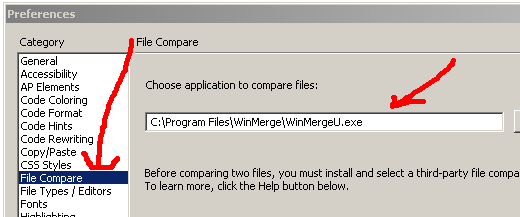
Once downloaded , go to Dreamweaver on the menu bar select -> Edit -> Preferences

Then locate file compare and browse to the WinMerge exe file

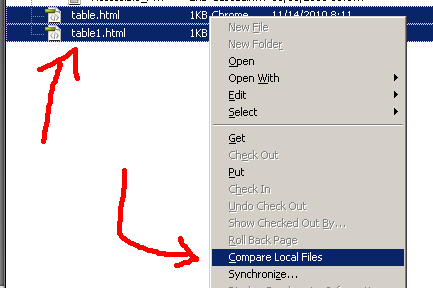
Now in order to compare files, just hightlight the file files in your Dreamweaver file explorer and click on “Compare Local files”

PDF Shows blank Blank Page (All Browsers)

After I removed my Adobe PDF  Software from my system, I could no longer access pdfs using  any the web browsers (Firefox, IE, Chrome) despite the fact
I downloaded and installed FOXIT pdf make it my default program.
I  then tried to access the same PDF with the IE (no adds-on) and i was successful. I am like Hmmm! maybe the previous uninstall left some residual browser integration information on my system. 

Solution : I ended up reinstalling ADOBE Reader and Use my Revo Uninstaller to remove the software.

Other Links that you might find useful:
http://kb2.adobe.com/cps/328/328233.html

Programmers and Webmasters’s Routine CSV Databases

My goal with this page is to make sure that these routines databases are always available all the time . I still see a lot of websites out there who are trying to sell a list of US 50 states (Come on!!!). Honestly, I don’t get that , but then again a lot of companies are selling water out there and a lot of people (including myself ) are buying them.  I guess if people want to buy it just sell it to them.

We have located a few sites on the internet and  we have put together a few CSVs that you might find useful (please do not forget to voice your opinion in the comment section below).

All Countries and Capital
http://code.google.com/p/routinelists/downloads/detail?name=countries.txt

All US States
http://code.google.com/p/routinelists/downloads/detail?name=us_states.txt

All US Cities and State
http://code.google.com/p/routinelists/downloads/detail?name=cities_states.txt

ZIP, CITY and States
http://code.google.com/p/routinelists/downloads/detail?name=zip_city_state.txt

Area Code
http://code.google.com/p/routinelists/downloads/detail?name=area_code.txt

International Phone Code
http://code.google.com/p/routinelists/downloads/detail?name=phone_international.txt


Miscelleaneous

All Countries in the World
http://www.iso.org/iso/english_country_names_and_code_elements

Others
http://www.cs.princeton.edu/introcs/data/

City and ZIP Codes
http://www.boutell.com/zipcodes/

Enable auto-reconnect VLC Streaming

“NOT INTUITIVE” that all I can say about some of the configuration options in VLC. You are really finding out that something is not intuitive when you have the directions and still not able to find the options.  Most open source software suffers from one thing: shaky UI design and from what i can see this software is no different.

If your stream stops after each song, you might not have auto-reconnect enabled on the client side.

Here is how to  enable auto-reconnect:

Let’s see how to enable auto-reconnect in VLC

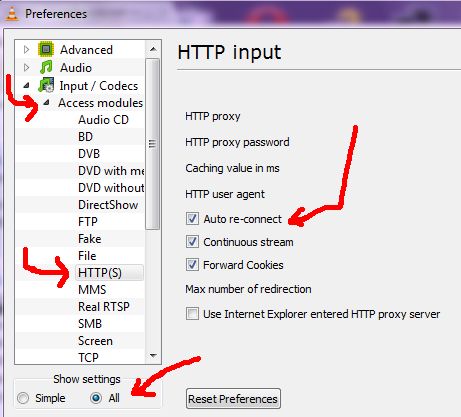
1. Click on Tools then Preferences.

2.  Click on “ALL” (show settings-> bottom left corner) see image below

3. The click on “input/codecs” -> Access modules

4. And click on HTTP(s)